


Saturday, November 6, 2010


Friday, November 5, 2010

Friends, I'd like to introduce you to New Male Pattern Boldness -- caffeine free, low in sugar, and remarkably gentle in your wash cycle. Sadly it remains as calorie dense as ever and dangerously high in sodium, but our staff scientists are working on it.
I can't say I'm feeling better after five days off caffeine and sugar because I feel worse. I'm not sure how much is due to caffeine withdrawal and how much is just plain old stress. I needn't remind close readers that my brother is getting married this weekend, and tonight starts three days of wedding festivities (his lovely fiancée hails from Mumbai, which explains the three-day thing). I only hope my brother remembers. I'm not sure what I'm wearing but whatever it is, it had better be in my closet already. I think if I felt a little better health-wise I'd be more excited. Maybe a cup of coffee.
I experienced another night of intermittent ear flapping and I do think it's time we crated those animals at bedtime. They hang out in their crates a lot so it's not like they'd be in jail or anything.
Of course more stressful than an Indian wedding is dealing with off-grain houndstooth, which brings me to the thrill ride that is McCall's 2242. You'll be happy to hear that I am nearly finished with the tunic.
Here's a peek at the back:

And here's the front:

I decided that topstitching was not necessary after all; I think it's more elegant without. It still needs sleeves, but you get the idea:

Sort of Robin Hood meets Valley of the Dolls, no?
I am hoping to get started on the shorts and then the long pants (in the black and white houndstooth) but I am not sure how much sewing I am going to be able to get accomplished between the wedding and my low energy. Maybe I have low-grade food poisoning (Is there such a thing?) or a mild flu. Or just post election nausea.
Oh, I also picked up some tricot knit interfacing for the jacket, as well as black bias tape for trim. I'll have to figure that one out.


Readers, aside from your usual aches and pains, compulsions and phobias, I hope you find yourself feeling well today. The weekend is upon us.
For those not attending an Indian wedding, I hope you have time to yourselves to do the things you love to do. And please think of me.
Happy Friday, everybody!
Thursday, November 4, 2010

Good morning, goths, punks and other disaffected subcultures who may or may not hang out in shopping malls and scare the rest of us. Yesterday's comments reminded me that I have a much more diverse readership than I'd ever imagined. How you found me I'll never know but welcome just the same. Especially you poor unloved Emos.
Readers, I have not been feeling quite up to snuff these last few days. Perhaps I am experiencing caffeine and sugar withdrawal as I've quit both cold turkey since Monday. (I am so over chamomile tea, I could cry.)
I thought I would sleep better without the caffeine but now I'm thinking the real cause of my poor sleep is sharing my bed with two chihuahuas, one of which (Willy) cannot decide whether he wants to sleep under the covers or over the covers and punctuates each move with a loud ear flap. Something has to change.
But enough about me and my bedroom problems.
McCall's 2242 has arrived and I have officially started my One Pattern Wardrobe project, though due to compromised health, without my usual high energy.
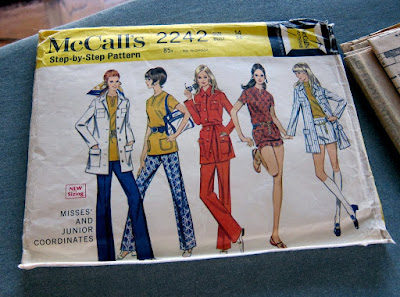

There's nothing remarkable about this pattern at all, but it was issued at the time the major pattern companies changed their sizing (What used to be 16 was now a 14, etc.), and there are reminders everywhere to pay attention before cutting.
Does anybody know why they did this? (They'd done it once before in the late Fifties.)

To my surprise, with the exception of the shorts, the pattern was uncut. Imagine buying this pattern and only making the shorts!
I cut my red and black houndstooth, which will become the tunic top and short pants combo.

The houndstooth is actually printed on the cotton twill and it's an eensy bit off grain, but so be it. No going back now. I can't figure out whether to topstitch in red thread or black and I actually brought this question to my Facebook page (Yes, Male Pattern Boldness is on Facebook! See right column of blog) yesterday with exciting results.
Of course there was no consensus but is there ever? What do you think? The weird thing about houndstooth is that the plaid creates an optical illusion: whichever color of the two you're focusing on looks like the background, with the checks in the other color. And vice versa. Do you know what I mean?
I also started testing interfacings on the black and white double knit. The only one that worked -- that stayed on when I stretched the fabric -- was the loosely woven weft weight. The tightly woven interfacing pulled off, which makes sense.
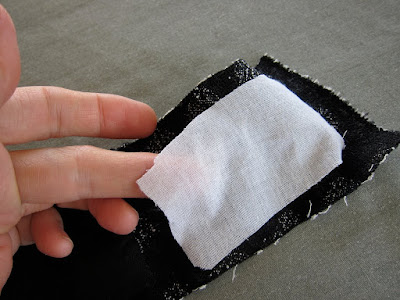
I may go to the store and pick up a knit interfacing, which is really what this fabric calls for. (It's just for the collar and facings.) Interfacing should have similar properties to (as?) your fashion fabric.

And that's it, friends. It's pouring here and very dreary, which means the dogs probably won't go out. But, aha! We have the trusty dog treadmill!
This video is a mere 45 seconds long and as you'll see, the dogs have made quite a bit of progress over the last month, especially little white Willy, the inveterate ear flapper. And the song will really take you back.
I saw Chitty Chitty Bang Bang in its original release -- twice. I recently tried watching it on DVD and it was as tedious as I'd remembered it. It really should be used solely for punishment. If your child has been bad I recommend a few hours of Chitty Chitty Bang Bang (the opening credits alone last ten minutes), followed by Doctor Dolittle, and perhaps a few hours of Julie Andrews in Darling Lili or Star! (Any overproduced late Sixties muscial will do.) Your child will never give you problems again, promise.
Stay dry everyone and if you're drinking coffee, well, I don't want to hear about it.
The most excruciating children's film ever made (which I also saw in its original release):
Happy Thursday, everybody!
Wednesday, November 3, 2010

Readers, as little as I know about fashion, I know even less about fashion subcultures. But I would like to learn and I need your help.
I've always been intrigued by groups of people who like to dress in unusual ways and hang out together. I know a lot of groups have found their inspiration in rock bands. Since the last band I listened to was The Partridge Family, I'm way out of the loop.
I think Goth has to do with dressing like a corpse and eroticizing death. Is that the basic gist of it? I hope I don't sound glib.

As with every Western fashion subculture, there exists its slightly kooky Japanese hybrid. Hence Gothic Lolita:

Kind of Goth, kind of TGIF cocktail waitress.
As a child of the Seventies, my first exposure to fashion subcultures was the greaser. There was a popular Broadway musical, Grease, which celebrated greaser culture. (Who didn't perform a version in their high school or summer camp?) And there was Fonzie on TV's Happy Days.
Real greasers were working class kids in the Fifties who liked to race cars, cut school, and smoke cigarettes. They were called greasers because they put a lot of grease in their hair. There was no mousse.

Of course today the greaser is little more than a nostalgic memory. When you are child's Halloween costume, it's over.

Needless to say, the Japanese love the greaser too.

As I got older, I became aware of punks. Punks wore black leather jackets like the greasers, but they also liked to put safety pins through their clothes and bodies and they could be violent. I read a book by the late Malcolm McLaren, who managed the Sex Pistols, all about the early days of punk, but I forgot what it said.


Like the Goths, punks wore a lot of black and eye makeup, but in a more varied palette. Where the goth is black and blurry-edged, the punk is metallic and sharp. Ouch!
Here is the somewhat more wholesome Japanese version. Is it me or are they always holding shopping bags?

Finally, there's Emo. I had never heard of Emo but I'd see the term used in ads on Ebay for things like used Lacoste tennis shirts. I had to look it up. Kind of adolescent skater-dude meets preppy-with-dirty-hair.


Of course there are other fashion trends: saggers, grunge, preppies, rappers -- but I'm not sure they constitute true fashion subcultures. Or do they? I don't know.
Readers, I fear I have done an injustice to fashion subcultures around the world. I don't get out much and my musical tastes tend toward Your Hit Parade circa 1953 with a dash of late-era Lerner and Loewe. I'm odd that way.
In closing, forgiving friends, have you ever been a member of a fashion subculture? What did your parents think?
Do you long for the days when you could pull on a pair of Doc Martens, paint on some black eyeshadow, stick something sharp through your nose, and feel like you belonged?
Or perhaps you are a parent of a child in a fashion subculture. Are you sweetly indulgent or openly hostile and given to rageful fits?
Have I missed any fashion subcultures of importance? Can you tell us about them and what they represent?
Please enlighten us sheltered city folk!

Tuesday, November 2, 2010

Imagine my surprise when I received an email yesterday from an enthusiastic new reader in Louisiana telling me I had helped convince her to buy a vintage Singer straight stitch sewing machine! I know I've been spreading the vintage sewing machine meme, but I never thought anybody was actually paying attention.
I thought this might be a good time to offer clear guidelines on buying a vintage sewing machine: the how, what, when, and where. (I've covered the why here.) I know many of you will have points to add, and I invite you to do so in the comments below.
So let's get started:
1. Where to buy a vintage machine
I've had good luck finding excellent vintage sewing machines on eBay, Craigslist, and at my local flea market. There are other places you might consider too: thrift stores, sewing machine repair shops (though you might pay more, you'll probably be assured the machine is in good working condition), garage sales, and estate sales.
The benefits of a site like eBay are that the selection is tremendous and changes daily. The downside is that you usually have to pay for shipping, which can greatly raise the total cost of the machine. High shipping costs can depress bidding, however, so one could argue that it evens out in the end. (For me, shipping costs higher than $20 send me elsewhere.)
Another downside is that you cannot actually test the machine. Therefore, if you're interested in bidding, you must ask the seller before you bid about the condition of the machine if it is not stated clearly in the description.
Many sellers will say they turned the power on and the light worked, or they pressed the pedal and the needle went up and down, but that's it; they don't know anything about sewing machines. Sellers who claim not to know anything about sewing probably don't know anything about how to pack and ship a machine either. Caveat emptor.
Craigslist is ideal in that you can see the machine and test it before buying. The machine won't be delivered to your door, of course; transportation is your responsibility. Great deals can be found on Craigslist and, depending where you live, the selection can be excellent. Some people are even giving away machines free.
If you're examining a machine at a flea market or garage sale, ask if you can plug it in and try it. There's usually someplace this can be done.

2. What to ask the seller?
On eBay, most sellers answer these questions in their description, but many do not because it doesn't occur to them or they think it's not their responsibility. In no particular order:
Does it work? Does it have any mechanical problems?
Is it missing any parts? (They may not know.) Does it come with a manual?
Some sellers are extremely thorough and knowledgeable about machines, others are not. Many sellers claim not to have the pedal, which allows them to claim no knowledge of whether the machine works or not. I would not bother with a machine like that.
If the machine does embroidery stitches, ask if you can see a stitch sample (this is especially important on eBay). Many people post a stitch sample and some even upload a YouTube video.
If it uses external cams, are the cams included with the machine? (If not, do you really want to hunt them down? I don't.)
If it's a foreign made machine, make sure it is wired for American outlets (or whatever outlet you use in your country). You don't want to have to buy an adapter, which over time can strain a motor.
Does it sew forward and reverse?
Do the feed dogs drop (if you'll be doing free motion embroidery)?
Is there any rust? (I would not take a chance with a rusty machine.)
What condition is the wiring in? Are there any cracks in the wire or taped areas? (Are you willing to rewire if necessary? I once attached a foot pedal to a machine that had had a knee pedal. It wasn't hard but not everyone would want to deal with that.)
Does it come with any attachments?
If there's only a photo of the back, ask to see the front. If the photo is so blurry you can't make out the model, ask for a better photo. Or don't and hope you're the only bidder on a great machine no one else can identify.
3. Risks worth taking
Let's face it: a lot of the appeal of buying a vintage machine is finding a hidden gem. If you are knowledgeable about machines and willing (eager!) to do what it takes to get the thing running, by all means take a chance on a frozen machine. Most of the time a frozen mechanical machine has not been oiled in decades and only needs a good lubrication to get it working again.
Or maybe the pedal is missing and you're confident that -- like most mechanical straight stitch machines -- there's simply not that much that could be wrong with it. If it looks good (on both top and bottom) and you know how the machine is supposed to work, give it a try.
4. My own preferences
I know what I will do and will not do. I will clean a machine and I will oil a machine but that is it. I will not purchase spare parts (other than presser feet, extra bobbins, or a light bulb) to make the thing run. I am not interested in restoring an old machine to like-new condition or stripping and refinishing a wood cabinet. But plenty of people are. I do not want to have to bring an old machine in to be serviced. I never have and hope not to need to any time soon.

5. Shipping
Most old sewing machines are heavy -- 20+ lbs heavy. Some weigh nearly twice that much. You simply can't pack a heavy piece of machinery the way you would a handbag or a pair of shoes. Sellers should be willing to double-box their machines and use plenty of bubble wrap and packing peanuts. The pedal should be wrapped separately. There should be no metal against metal.
If you're shopping on eBay, look at the seller's feedback. Is it 100% positive? Read the negative feedback. Do other buyers mention the quality of the packaging? Check the seller's recently sold items. Do they sell sewing machines or other fragile and heavy equipment?
It's always good to ask the seller directly how they plan to pack the machine.
6. What models should I look for?
I am completely subjective when it comes to vintage machines. I know what I like and that's it. I think nowadays most people want a zigzagger first and foremost. I own a few vintage zigzaggers, including a Necchi, a Kenmore, a Viking, and a Singer. The Sears Kenmores with 158 in the number are very highly regarded. Most were made in Japan.
Necchis from the 50s and 60s, like the Supernova, are very well engineered machines. Most come with external cams for embroidery stitches. Do you want to deal with cams? I've learned from experience that I do not.


I have a simple early Eighties era Viking I like a lot. All I ever use a zigzagger for these days is the occasional satin stitch on a pocket or to install an invisible zipper (the only invisible zipper foot I have fits on the low shank adapter of my Viking). Now that I have a serger, I rarely overcast. So it will come as no surprise that I prefer straight stitch machines. I have Singers and one White. I think the Singers are unmatched. They're easy to use, easy to maintain, and stitch beautifully. You can find most Singer manuals online free, and there are many online groups for owners. I like to be able to sew slowly at times, and all my Singers excel at this. It's not just the pedal: it's the engineering.

7. What else will I need to purchase?
One of the benefits of old Singer straight stitchers is that all the old feet and attachments are easy to find on eBay and Etsy. Millions of these machines were sold so the parts aren't rare. Many can even be found new, though usually made in the Far East and of inferior quality. Once you start looking around for these feet, you find them everywhere. Singer buttonhole attachments are great and can still be found for $20 or less. You can even find zigzagger attachments (I have one) that will allow your straight stitcher to overcast.
You'll need sewing machine oil, and for some machines that are truly frozen, other solvents that can break down old shellac. I'm not an expert but you can find plenty of tips online about restoring old machines. If you have some good resources you'd like to share below, please do so.
Old machines need plenty of oil. I usually oil my machine before beginning any big project.
8. Does a straight stitch machine really stitch better?
I think so. It's not just the quality of the individual stitch; any machine with balanced tension can produce a perfect stitch. Straight stitch machines offer better control, especially for topstitching and edgestitching. The needle hole on a straight stitch machine is tiny, making it less likely that delicate fabric will get pulled through the hole. The right side of the straight stitch foot is a mere 1/8", making it very easy to see what you're stitching when you're in a critical place, like topstitching a collar and turning a corner.
Most of these old machines can handle multiple layers denim and leather just fine; whatever you can fit under the presser foot in my experience. They may not be up to upholstery, but some are!
NOTE: None of my machines are true industrial machines. No Singer home model (66, 99, 192K, 201-2, 15-91, etc.) should be described as such in an eBay posting.
9. Bidding strategy.
The most popular time to buy on eBay is Sunday night (I think Wednesday or Thursday is the next popular). I generally avoid that time. You're more likely to get a good deal on Friday night or Saturday. There are generally few bidders during the day, when most bidders are at work.
REMEMBER: there are thousands of vintage sewing machines for sale on eBay every month. The model you want will reappear. No sense getting caught in a bidding war. Let it go. It will be back.
10. How about "Buy it Now?"
I bought my first vintage machine on eBay using "Buy it Now." I knew nothing about sewing machines and the seller had an excellent reputation and had even posted a YouTube video of the machine in action. In retrospect, I paid too much for my Kenmore machine but it was worth it to know I was getting a machine that didn't have mechanical problems. It also came with a buttonhole attachment.
You'll almost always pay more with the "Buy it Now" option. But sometimes the convenience makes it worth it. I don't think anybody's getting rich selling old sewing machines on eBay, so you could argue you're supporting a fellow sewing machine aficionado.
And that's it!
Are there any questions I haven't addressed? Do you have advice to share?
Has your experience been similar to mine? Have you ever gotten stuck with a dud?
Jump in!
Monday, November 1, 2010

Good morning, everybody, and Happy Day of the Dead to those (living) who celebrate it. I don't know about the weather where you live, but here in New York it's getting cold. Almost too cold for a velveteen jacket.
As you can see, I've been slowing introducing my new jacket to the outside world and so far, so good. I do notice that it doesn't go especially well with the blue of my jeans but I do like it with mixed plaids.

Readers, if I start to look like one of those Japanese kids on Harajuku Street, you will tell me, won't you?

You don't even have to say it explicitly -- a simple "!" will suffice. I am definitely getting more confident about mixing patterns and it's a slippery slope to the Hello Kitty lunchbox and embellished Uggs.
Readers, I'm not one to linger in the past, but occasionally I will happen upon something that reminds me where I was at a certain moment in my life and, consequently, where I am now. Does this ever happen to you?
I don't know why I was digging through Michael's underwear drawer -- boredom? -- when I happened up these.

Sentimental MPB followers and lurkers, those gingham boxers were my very first sewing project, which I made in June 2009. Aren't they pretty?
I made them using Diana Rupp's book, Sew Everything Workshop. It's a project called Foxy Boxers and Rupp's book comes with the actual paper pattern included (among many others). I always recommend this book for beginners because it's so good on the basics and very stylish.


Trust me when I say I had no idea what I was doing and no familiarity with sewing terms when I took on this project. It took me about three days to finish them (I'm not kidding). And as pretty as they are on the outside, inside they're a bit of a mess.
Let's take a look at the inside fly. I still don't understand how I ended up with this huge inside flap.

Or why I didn't clip this seam to help the fly opening lie flat...

Forget about overcasting seam allowances. Today they're all fraying.

Below, on the inside back seam, you can see I was stitching a second seam in zig zag, but a) the tension was too tight on my machine, and b) I never cut the seam allowance down to the stitching line. So despite zigzagging the seam allowance there's all that fraying.

Here's another area of yuck, where the leg and side seams intersect.

To my credit, the waistband casing came out pretty well.

And despite everything, I am still proud of them, and will promptly re-bury them in Michael's bureau.
I thought it was useful to take a fresh look at those boxers because I was reminded that you really can't go from A to, say, K, without passing first through B, C, D, E, F, etc. The only way to learn is to make mistakes and then figure out what went wrong.
If you don't have someone nearby to ask, you can ask questions on Pattern Review or take a look at a RTW garment of the same type and see how it's constructed. That is something that never occurred to me while I was making those boxers. I had a dozen boxers I could have examined to help me figure things out. But that was something I had to learn too!
Readers, the week ahead is a big one, ending in my brother's wedding. But more importantly, I am hoping I get my 1969 McCall's pattern in the mail. And look at the photo I found online yesterday: Yves Saint Laurent Spring/Summer collection, 1969.


Do womens sewing patterns today reflect current fashion trends as immediately as they used to? I wonder.
In closing, friends, do you ever go back and revisit old projects and recognize the progress you've made? If you don't, you should. Now I understand why Michael complained about getting tangled up those boxers -- it's dangerous in there!
Have a great day, everybody! What are you working on?
Subscribe to:
Posts (Atom)


